From the Sky to the River
My right hand is in their left pocket. We’re walking together.
All of a sudden, with no sign of it anywhere, it starts to rain.
I start walking faster. So do they.
My hand is still in their pocket when my foot suddenly slips — but instead of falling, I get light
and lift off. I go up into the sky. Them too.
Just like that, we get mixed in with the rain, we turn into cloud, we turn into wind.
We become thunder and lightning.
“Don’t take your eyes off me,” they tell me.
I say, “I won’t.”
It means: don’t leave me.
It means: don’t let me get lost among all these raindrops.
Don’t let the wind take me, don’t let the thunder freeze me.
My heart is craving hot tea.
My heart wants the curve of the road and the sound of the windshield wipers.
My heart wants the anxiety of tunnels, the fear of bridges.
I tell them, “Don’t go anywhere, let me go bring an old, scratchy tape, put it in the player so we
can dance together.”
They say, “But I don’t know how to dance.”
I say, “It’s nothing. Just let yourself go. Become a river.”
I pull my hand out of their pocket and the rain stops. My eyes are on the asphalt.
A cold numbness starts from my left elbow, climbs up, and reaches my brain. My brain burns.
“Are you okay?” they ask.
I say, “Forget the tape. Come dance with our pain.”
I see them spinning, their hand moving, their body turning into waves.
I look at them. I don’t take my eyes off them.
Ever.
From the author: We never really know the border between our imagination and reality, although we try hard to define this border through common sense, pop culture, or the apparent solidity of objects. But we fail: when we look closely enough, doubt and what we call the unknown exhibit themselves in the crevices of our binary definitions, like the space between stars, like the space between electrons and the nucleus.
In this abstract piece I challenged myself to make this arbitrary line blurrier. When we fall, we are ascending inward; when we feel pain and our existence is challenged, we feel our unity with our surroundings—rivers, clouds, and asphalt. In this sense, patterns are the only reality, like the shape of a whirlpool, not the water. I see gravity—the connection between us, and between us and objects—as reality. Whether toward the sky or toward the river, the dance, as a pattern of movement rather than a thing to be touched, and the friendship between the characters are real.
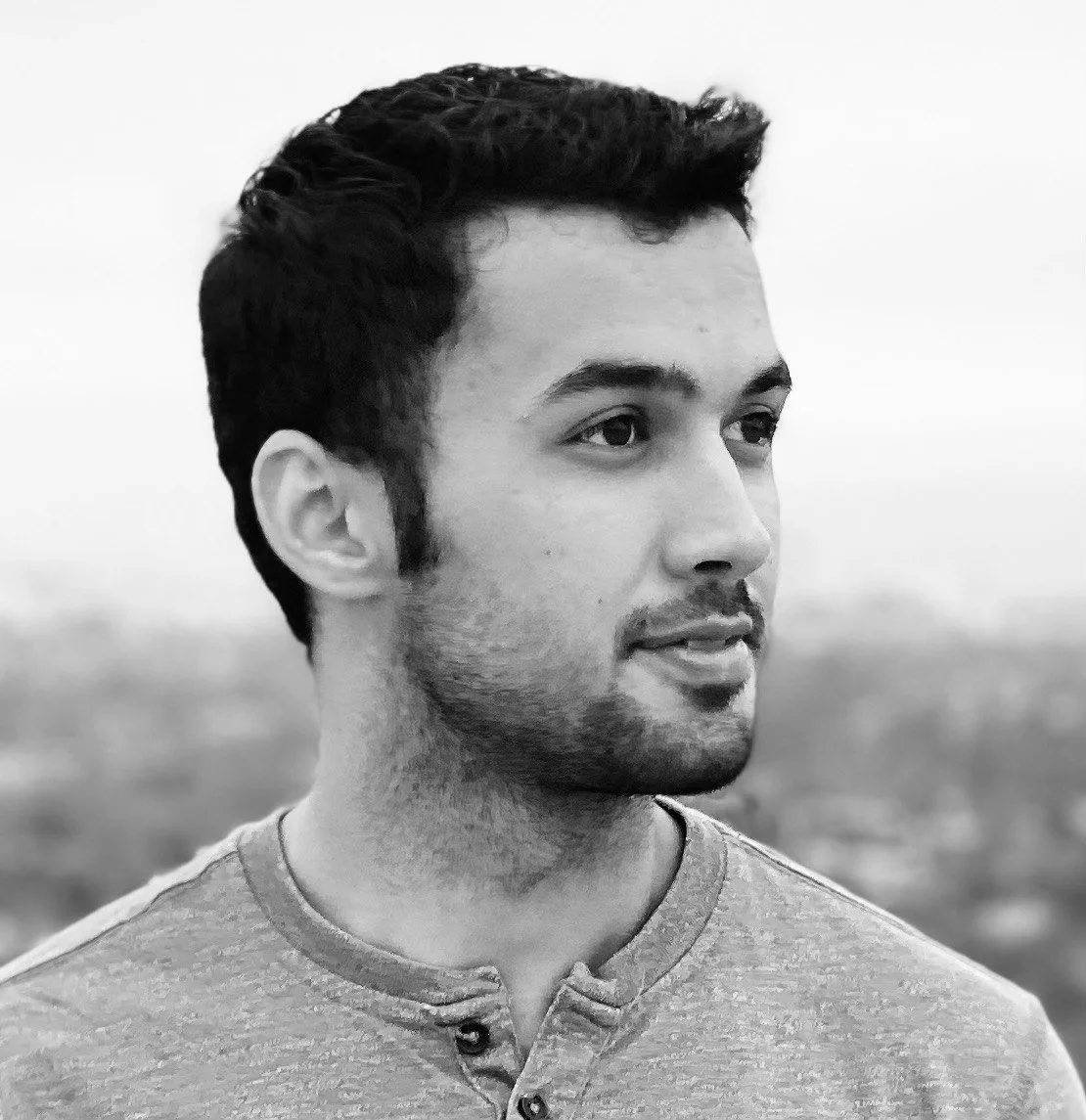
Saleh Sereshki is an Iranian-born artist and poetry lover based in New York City. He earned a PhD in computer science in California after moving to the United States, while keeping art close throughout. In 2025, he relocated to NYC and now works as a postdoctoral researcher at Mount Sinai. The unknown draws him to the space between science and art: he believes science matters most when it admits what it cannot yet explain, and that poetry makes those uncertainties tangible.
Quisque iaculis facilisis lacinia. Mauris euismod pellentesque tellus sit amet mollis.